Why Modern Handleless Kitchens Are Redefining Luxury Living
I have spent the better part of two decades designing kitchens, and I can tell you that the single most common request I hear now is for something clean, something that does not shout, something that feels more like a piece of furniture than a room full of cabinets. That is where modern handleless kitchens come in. They are not a trend. They are a fundamental shift in how we think about the heart of the home.
When I first started out, handles were the jewellery of a kitchen. We spent hours picking the perfect brass pull or the slim stainless steel bar. But over the last ten years, I have seen that focus shift entirely. Now, the beauty is in the surface itself. The uninterrupted run of a lacquer finish across a bank of cabinets, the way light moves over a quartz worktop without being broken by a metal protrusion. That is the new luxury.
The Rise of the Handleless Cabinet
Handleless cabinets are not a new invention. They have been common in commercial spaces for decades, where durability and ease of cleaning matter more than ornament. But the leap into high-end residential design happened when brands like Siematic and Bulthaup started treating the handleless profile as a design statement rather than a cost-saving measure. They proved that a kitchen could be both minimal and deeply luxurious.
What makes a modern handleless kitchen different from those early commercial versions is the engineering. The best systems use a recessed channel behind the door front, or a clever J-groove that lets you hook your fingers without seeing any hardware. Soft-close hinges are standard now, but in a handleless setup they are essential. Without a handle to slow your pull, the door needs to close just as gracefully as it opens.
Why Homeowners in Glasgow Are Asking for This
I work mostly in and around Glasgow, and I have noticed something interesting. Scottish homeowners tend to be practical. They want a kitchen that works hard, but they also have a strong sense of style. In a city where space is often at a premium, the clean lines of modern handleless kitchens help a room feel larger. There is no visual clutter. Your eye travels across the room without being caught by a row of handles.
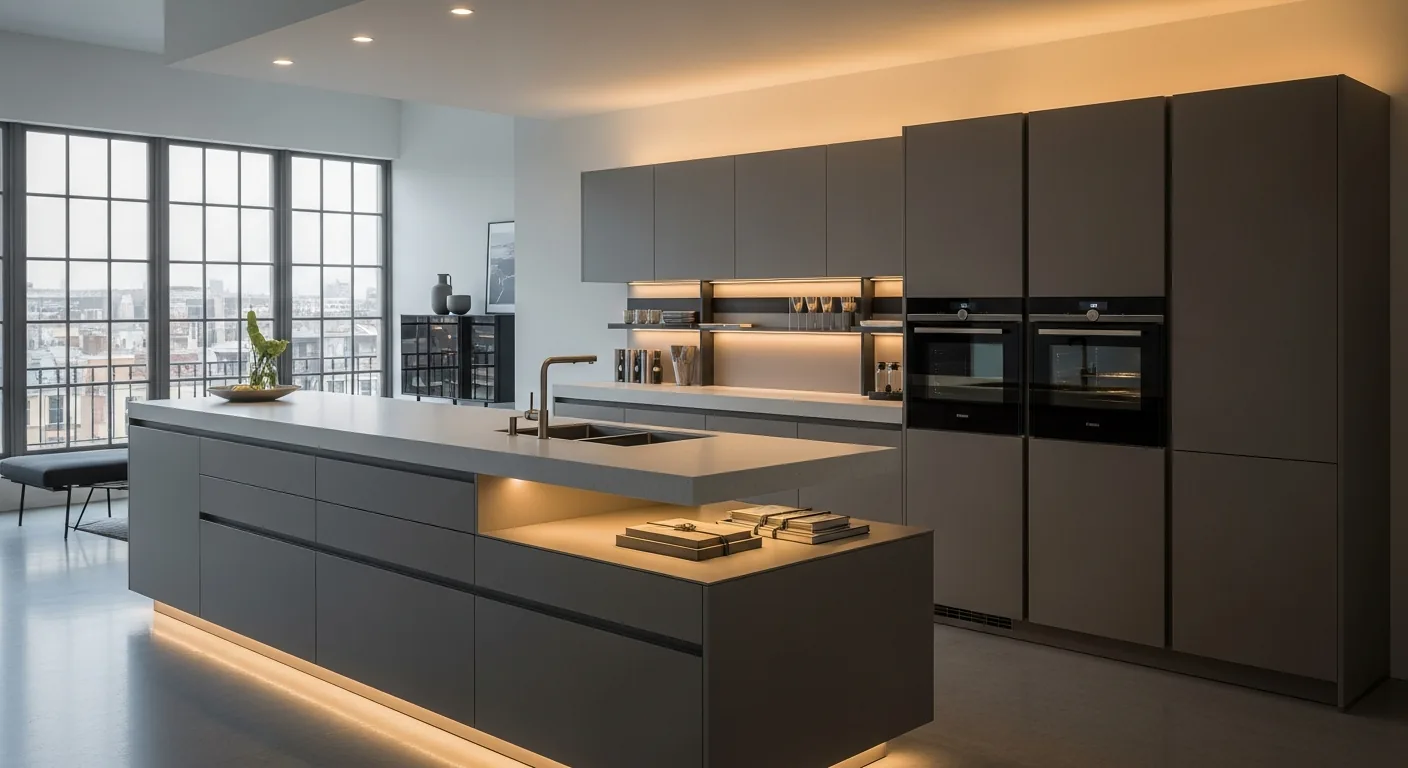
One of my recent projects was a Victorian tenement conversion. The living space was open-plan, with the kitchen flowing into a dining area. The clients had chosen a Poggenpohl system in a soft grey lacquer finish, with a large kitchen island finished in a contrasting timber. The island had a breakfast bar overhang, and we fitted integrated appliances throughout. The result was a kitchen that felt almost invisible. It was there when you needed it, but it never dominated the room.
The Materials That Make It Work
A handleless kitchen demands a certain level of material quality. When there is no hardware to distract the eye, the surface finish becomes the hero. That is why luxury materials matter so much here. Lacquer finishes are a popular choice because they offer a deep, reflective colour that changes with the light. If you want something more tactile, a matte textured finish can be just as striking.
Quartz worktops are a natural partner for this style. Their seamless look complements the uninterrupted lines of handleless cabinets. I have also seen beautiful combinations with natural stone, though quartz tends to be more practical for everyday cooking. The key is to keep the worktop profile simple. A thick slab with a eased edge works best. Anything too ornate breaks the visual flow.
Integrated Appliances and German Engineering
One of the biggest advantages of a handleless design is how easily it accommodates integrated appliances. You can hide a full-height refrigerator behind a panel that matches the rest of the run. The same goes for dishwashers, freezers, and even coffee machines. Brands like Sub-Zero and Wolf build appliances specifically designed for this kind of integration. Their cooling units use the same panel thickness as standard cabinets, so the transition is seamless.
German engineering plays a huge role in making this work. Poggenpohl, Siematic, and Bulthaup all invest heavily in precision manufacturing. Their cabinet boxes are square, their doors are flat, and their hinge systems are engineered to hold alignment over years of use. When you combine that with British craftsmanship on the installation side, you get a kitchen that feels solid and will last.
The Trade-Offs You Should Know
I would be doing you a disservice if I pretended handleless kitchens were perfect for everyone. There are trade-offs. The biggest one is cost. A high-quality handleless system from a brand like Bulthaup is expensive. You are paying for the engineering and the materials, not for decorative hardware. But if you compare it to a traditional kitchen with high-end handles, the price difference is often smaller than you might think.
Another trade-off is the learning curve. Some people find handleless cabinets less intuitive at first. You have to reach for the groove rather than a handle. It takes about a week to become habit, but I have had clients who never quite got used to it. I always recommend spending time with a showroom sample before committing. Open every door. Close every drawer. See if it feels natural to you.
Cleaning is actually easier in most cases. There are no handles to collect grease and dust. But the grooves do need occasional attention. A soft brush or a vacuum attachment works well. Avoid abrasive cleaners on lacquer finishes. A damp microfibre cloth is usually all you need.
Design Consultation and the Role of Lighting
When I do a design consultation for a handleless kitchen, I spend a lot of time on lighting. Ambient lighting is critical. Because there are no handles to cast shadows, you need to think carefully about where you place your light sources. Under-cabinet lighting becomes even more important. It highlights the work surface and creates a soft glow that makes the whole kitchen feel warm.
I also look at the overall layout. Open-plan living has made the kitchen island the centre of most modern homes. In a handleless design, the island should feel like a piece of furniture. You might finish it in a different colour or material to the main run. That contrast can be the defining feature of the room.
Final Thoughts on Bespoke Kitchens and Personal Style
Bespoke kitchens are not just for the ultra-wealthy. They are for anyone who wants a space that works exactly the way they live. A handleless design forces you to think about storage in a more disciplined way. You have to plan where every pot, pan, and utensil will go, because you cannot hide clutter behind a handle. That discipline often leads to a more organised and enjoyable kitchen.
If you are considering a modern handleless kitchen, I would start with a clear idea of how you cook and entertain. Talk to a designer who understands the technical requirements. Look at real materials, not just pictures. And do not be afraid to mix styles. A handleless kitchen can work with a traditional farmhouse sink or a vintage rug. The key is to let the architecture of the space guide you.
In the end, a kitchen is not about trends. It is about how it feels to be in it. And for me, there is something deeply satisfying about a room that is calm, quiet, and built to last. That is what a well-designed handleless kitchen delivers.